Finding Wholeness in the Both/And: Holding Grief and Aliveness Together
Dec 29, 2025This week was a week of Both, And. On the same day, every single day this week I heard stories of devastation and also massive miracles. I've cried so many tears this week, both from sadness and heartbreak and with such deep joy from what I got to hear and bear witness to.
My heart breaks for the families in Australia and all over the world who are entering into a portal of complicated grief, a new reality without their loved ones so shockingly taken from them.
I've been reading Francis Weller's book for the 10th time at least, "The Wild Edge of Sorrow" (I love re-reading books I love). It is a work that really honors grief, while honoring aliveness. The balance of finding something more alive than cynicism and despair, but also more alive than saccharine hope is found inside of those pages.
I've been feeling into and hearing from my clients that they have been noticing how at the beginning of one's healing path (in this lifetime) humans often enter to seek relief from suffering. Desiring to fix those parts they have become aware feel fragmented, exiled, or scattered.
But what some people along the way find is way more precious and rare than a certain relief, release or fixing - instead they find themselves finding wholeness, integration, aliveness, their essence.
They find peace with the pieces, their souls in their grief, their humanity in the overwhelm, their discernment in their anger, their surrender in the unknown, their power in their love, themselves in the mystery, and God in it all.
And that becomes more than enough, more than they ever knew to look for.
Shabbat Shalom. May we have capacity to hold reverence because we have capacity to hold grief, because we have capacity to hold joy, because we have capacity to steward life, because we have capacity to Be with ourselves and each other 🤍
Grief as Vitality: Wisdom from Francis Weller:
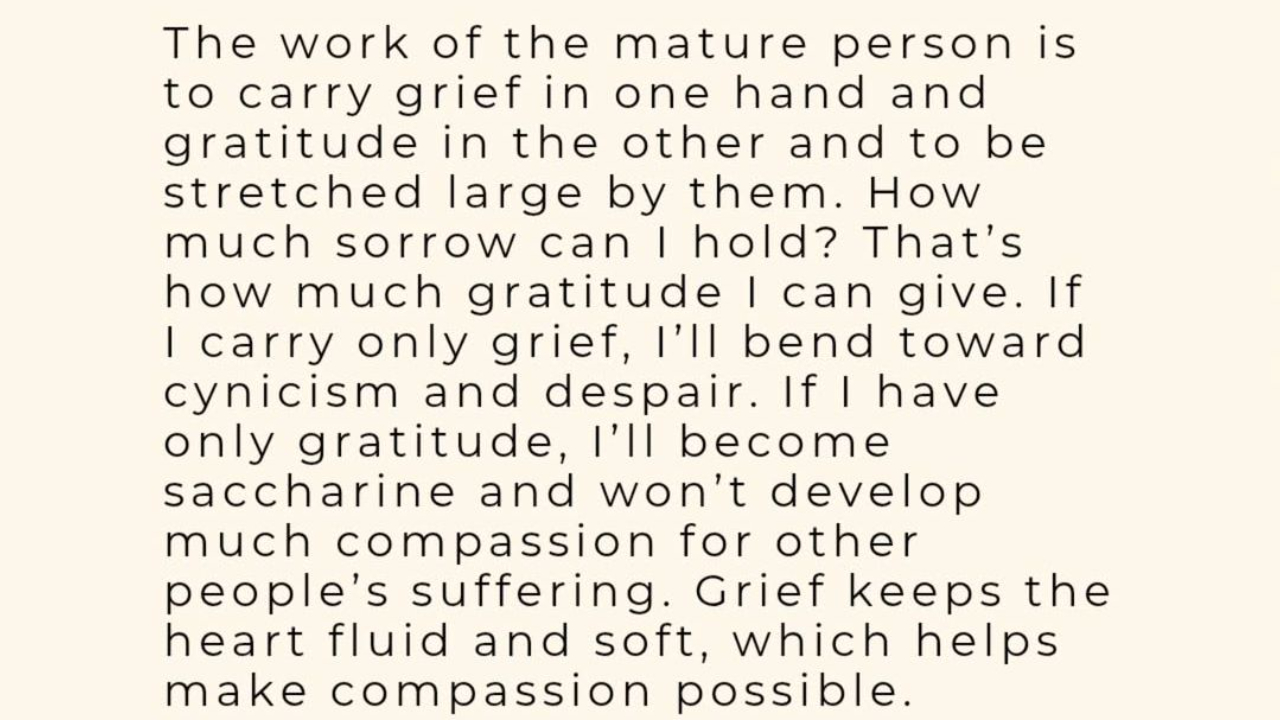
The work of the mature person is to carry grief in one hand and gratitude in the other and to be stretched large by them. How much sorrow can I hold? That's how much gratitude I can give. If I carry only grief, I'll bend toward cynicism and despair. If I have only gratitude, I'll become saccharine and won't develop much compassion for other people's suffering. Grief keeps the heart fluid and soft, which helps make compassion possible.
Grief and love are sisters, woven together from the beginning. Their kinship reminds us that there is no love that does not contain loss and no loss that is not a reminder of the love we carry for what we once held close.
There is something feral about grief, something essentially outside the ordained and sanctioned behaviors of our culture. Because of that, grief is necessary to the vitality of the soul. Contrary to our fears, grief is suffused with life-force.... It is not a state of deadness or emotional flatness. Grief is alive, wild, untamed and cannot be domesticated...It is truly an emotion that rises from the soul.
My daily practice is to wake and immediately bring my attention to this thought: "I am one day closer to my death. So how will I live this day? How will I greet those I meet? How will I bring soul to each moment? I do not want to waste this day.
When our grief cannot be spoken, it falls into the shadow and re-arises in us as symptoms. So many of us are depressed, anxious, and lonely. We struggle with addictions and find ourselves moving at a breathless pace, trying to keep up with the machinery of culture.
I'm not sure how or when I began my apprenticeship with sorrow. I do know that it was my gateway back into the breathing and animate world. It was through the dark waters of grief that I came to touch my unlived life. . . . There is some strange intimacy between grief and aliveness, some sacred exchange between what seems unbearable and what is most exquisitely alive. Through this, I have come to have a lasting faith in grief.
Grief keeps the heart flexible, fluid, and open to others.
To die before we die means that we must become radically honest with ourselves. We must shed the skins that do not foster aliveness. One man, while participating in the first weekend of the Men of Spirit initiation, suddenly realized how conscripted and narrow his life was. At that moment, he jumped out of his chair and flung it across the room in disgust. He clearly saw that he had unwittingly made an agreement to live small and to consistently tell himself what a good life he was living. This realization broke him open to the great well of grief he was carrying in his heart from all the times he had abandoned himself for the sake of fitting in and getting approval.
To alter the amnesia of our times, we must be willing to look into the face of the loss and keep it nearby. In this way, we may be able to honor the losses and live our lives as carriers of their unfinished stories. This is an ancient thought - how we tend the dead is as important as how we tend the living.
As long as the complex remains outside of awareness, we will find ourselves acting out of compulsion, reacting to scenes in our life with the same consciousness that was traumatized in the first place. What we seek is the ability to encounter life openly, freely and with soul. We cannot control what comes to us, what moods arise, what circumstances befall us. What we can do is work to maintain our adult presence, keeping it anchored and firmly rooted. This enables us to meet our life with compassion and to receive our suffering without judgments. This is a core piece in our apprenticeship with sorrow.
It is important to look into the shadows of our lives and to see who lives there, tattered, withered, hungry, and alone. Bringing these parts of soul back to the table is a central element of our work. Ending their exile means releasing the contempt we hold for these parts of who we are. It means welcoming the full range of our being and restoring our wholeness. Until then, we will continue to carry a feeling of worthlessness and brokenness. - Francis Weller